Did someone say we’re hyperconnected? Oh yeah, Mark Pesce did last week. And you know what? He did a keynote presentation at a conference this morning and someone’s blogged about it before he’d even left the room. And now I’ve blogged about the blog. And he still hasn’t left the room.
Twitter’s having a whale of a time
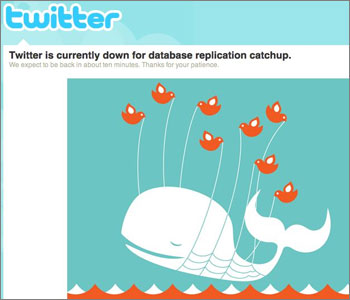
As I write this, Twitter is down for a “database replication catchup”. Sounds technical. As I hinted before, and as Kate Carruthers agrees, it’s make or break time for this most cool of messaging services.
It’s ironic that Twitter’s ability to connect us humans into an almost-instantaneous global network was a core theme of Mark Pesce’s keynote presentation at Microsoft’s ReMIX 08 last week. The very week he extols Twitter’s strengths, it collapses. And they don’t know why.
At least Twitter has responded to community calls for more transparency.
In Twittering About Architecture, Alex Payne admits they built it wrong from the beginning.
Twitter is, fundamentally, a messaging system. Twitter was not architected as a messaging system, however. For expediency’s sake, Twitter was built with technologies and practices that are more appropriate to a content management system. Over the last year and a half we’ve tried to make our system behave like a messaging system as much as possible, but that’s introduced a great deal of complexity and unpredictability.
I don’t need to repeat my call for less haste in web development — and in the world generally — do I?
Twitter has just received another $15M investment. Take the time to get it right, guys. But quickly.
Eurovision at the Pub tonight!

Only hours to go! Eurovision at the Pub is tonight at our local “Irish” pub, Kelly’s On King, 258 King Street, Newtown. The SBS broadcast starts at 7.30pm, but we’ll be there from 5pm or so to, um, ensure sufficient fuel for a long evening of big hair, tacky costumes and dodgy choreography.
There’s a Facebook event page, but even if you don’t use Facebook please RSVP here or to my Twitter stream or somehow. The more confirmed guests, the more free stuff the pub gives us.
I’ll be Twittering the event, as will many others, with the tag #eurovision. If I have enough bandwidth, I’ll also provide an audio commentary via Ustream.
Crikey: Australia’s web 2.0 wipeout on the wave of the future

[Note: This is a slightly edited version of an article I wrote for Crikey this morning. The main difference is a bit more linkage. There’s more CeBIT / Transaction 2.0 material to come.]
In 1980 futurist Alvin Toffler wrote The Third Wave. Following the Agricultural and Industrial Revolutions, he said, we’re now experiencing the Third Wave, or what might be called post-industrial society. Australia’s surfing prowess means nothing here, though. We’re still pissing in the shallows, barely held up by leaking floaties.
Why is tech-literate, well-educated Australia so bad at marketing and profiting from its own innovation, from the fisheye lens to gene shears? We do innovate, you know.
“Australians expect the government to do everything for them — but the government’s clueless,†explained journalist and evangelist Duncan Riley at yesterday’s Transaction 2.0 conference. “The Australia 2020 Summit is a classic example. The Internet was seen as an ’emerging’ industry. Emerging? We’ve had it for 20 years! In the US alone it employs 7 million people.”
Continue reading “Crikey: Australia’s web 2.0 wipeout on the wave of the future”
Episode 3 online!
For better or for worse, episode 3 of Stilgherrian Live Alpha is online over at Ustream. I did rant at the camera as threatened. I went for 45 minutes instead of 25 to 30 because I was looking at the wrong clock. I have destroyed my personal brand forever. Chat logs to be reviewed later.
Episode 3 happens tonight, no matter what
By tonight I’ll be exhausted after 3 days of geekery. If the nice long cough I just had is any indication, I’ll be feeling ratty for other reasons too. Nevertheless, episode 3 of Stilgherrian Live Alpha will be on the Internet at 9.30pm Sydney time — no matter how ill-prepared, no matter how ill. I suspect that the worse I feel, the snarkier I’ll get. There will also be embarrassing videos.