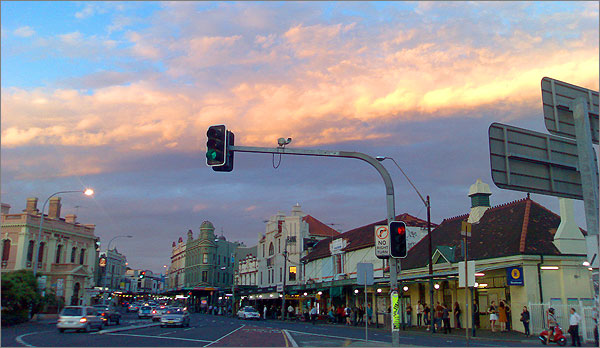
Too long since I posted a photo. I thought of taking a quick snap of the street but after 12 days of rain King Street looks bleak. Instead, here’s the glorious sunset scene from 26 March. Enjoy.

Word-whore. I write 'em. I talk 'em. Information, politics, media, and the cybers. I drink. I use bad words. All publication is a political act. All communication is propaganda. All art is pornography. All business is personal. All hail Eris! Vive les poissons rouges sauvages!
Too long since I posted a photo. I thought of taking a quick snap of the street but after 12 days of rain King Street looks bleak. Instead, here’s the glorious sunset scene from 26 March. Enjoy.
I won’t bother linking to news stories about the shambles that is the Olympic Torch Relay. I’ll just quote George Orwell. “Even if one didn’t know from concrete examples (the 1936 Olympic Games, for instance) that international sporting contests lead to orgies of hatred, one could deduce it from general principles.” Hat-tip to John Quiggin.
I noticed this blogging meme over at Quatrefoil’s place and thought I’d give it a try. The results are surprising.
And the sentence is:
“Sensitive site exploitation will continue.”
That sentence doesn’t make a lot of sense by itself, but the next one adds all the context you need:
So far there had been no WMD stockpiles found.
The book is State of Denial: Bush At War, Part III by investigative journalist Bob Woodward. It’s been months since I read it but for some reason it’s still on my desk.
This afternoon the BBC reports that unnamed “US officials” have evidence that North Korea was helping Syria build a nuclear reactor. Here we go again. I think I might listen to some classic Detroit techno instead.

Weird. I was thinking that today I might write about how I’ve been using Twitter recently, and I’ve just found myself writing in its defence.
Over on the Link mailing list were talking about Microsoft’s new Live Mesh when I noted:
It’s been interesting to watch the vastly different reaction here on Link with the (mostly) very positive reaction amongst the alpha geeks in my circle of friends on Twitter.
There, the reaction is all “When can I get a Mac version?” and “How can I hook this into X technology?” and about exploring the possibilities — what can be achieved. Here on Link, the reaction is often negative, “How can it go wrong?”, “Where do you sue?”.
Both reactions are necessary to provide a balanced response to a new technology. How to we get them to meet?
Systems administrator Craig Sanders was quick to respond, and I must admit I found his response to be almost a stereotype — something I later dubbed “old man syndrome”.
The world laughs at Americans because they seem so unaware of anything outside their own borders. Well, a client reports on an American colleague returning to the US head office after a business trip to Sydney. “You know Australia?” he told his office-mates. “It’s almost like another country!” Yeah. Almost. God bless America.
Jamais Cascio’s excellent reminder from yesterday’s Earth Day: “The grand myth of environmentalism is that it’s all about saving the Earth. It’s not. The Earth will be just fine. Environmentalism is all about saving ourselves.” A nice little essay. Hat-tip to Memex 1.1.