
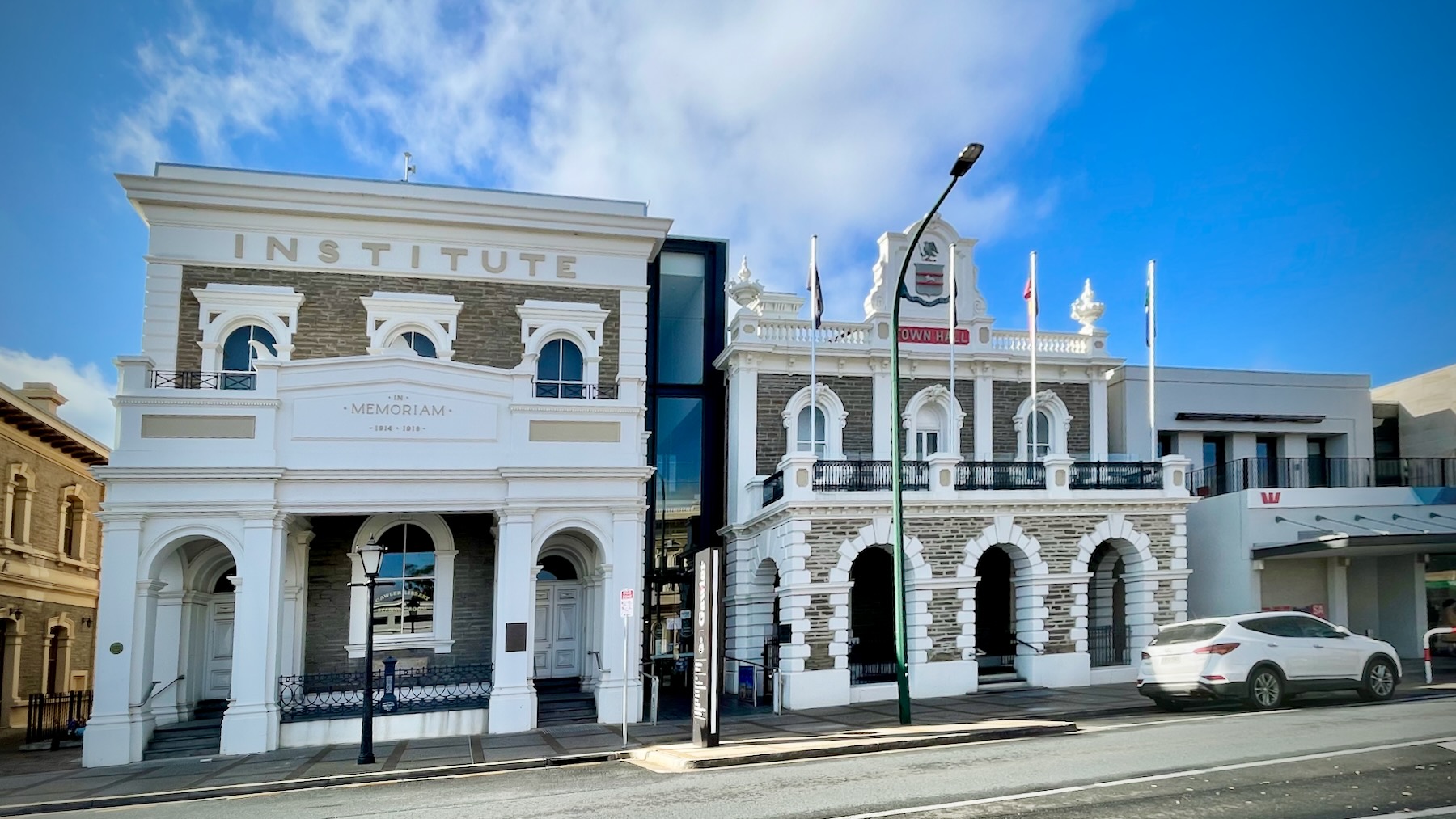
Today’s episode is a bit different. It’s more personal. I, Stilgherrian, was born in Gawler, South Australia, and lived there from ages 11 to about 17. Last year I visited the town with my good friend Snarky Platypus, and he asked me some pertinent questions.
In this episode, there’s memories of school, some history of Gawler, a rambling chat about science fiction and fantasy, television, music, and much more — including the true story of Australia’s favourite condiment, chicken salt.
The core material for this podcast was recorded on 29 June 2025.
This podcast is available on Amazon Music, Apple Podcasts, Castbox, Deezer, Google Podcasts, iHeartRadio, JioSaavn, Pocket Casts, Podcast Addict, Podchaser, Spotify, and Speaker.
You can also subscribe to the generic podcast feed.
Episode Links
-
A platypus of many talents, he/him, ???? ?????? (is that enough flags), politics, food, pop music and women’s basketball.
-
Gawler, established in 1839, is the oldest country town in the state of South Australia. It was named after the second Governor (British Vice-Regal representative) of the colony of South Australia, George Gawler. It is about 40–44 km (25–27 mi) north of the state capital, Adelaide, and is close to the major wine producing district of the Barossa Valley.
-
[23 July 2025] An invention of convenience, this now-ubiquitous Aussie seasoning is over 50 years old and has since conquered shops, restaurant menus and even film festivals. We meet the creator Peter Brinkworth.
-
Prince Alfred College is a private, independent, day and boarding school for boys, located on Dequetteville Terrace, Kent Town, near the centre of Adelaide, South Australia. The school has educated Rhodes Scholars, premiers and politicians, leaders of industry and finance, senior public servants, explorers and sportsmen.
-
Gawler Central railway station is the terminus station of the Gawler line.
-
Gawler East Primary School on Lyndoch Road was established in 1964, opening in buildings previously used as Gawler High School on Lyndoch Road. The school served the community as a primary school and is one of several educational facilities that have been at that site, alongside other primary and technical schools. The school is now Immanuel Lutheran School. The school relocated to its current site on Finch Road in 1985.
-
James Martin & Co. was founded in Gawler, South Australia about 1848 by James Martin as a blacksmith and wheelright business. It soon began to manufacture reapers. The opening of the Gawler railway line in 1857 allowed Adelaide, 41 kilometres (25 miles) to the south, to be reached more easily than via the primitive roads of the time... By 1888 James Martin had acquired more land to the south of the foundry having secured a contract for the manufacture of 52 locomotives for the South Australian Railways This was followed two years later by a contract for a further 92 engines.
-
[September 2024] Dr Lauren Samuelsson from the University of Wollongong is a cultural historian and recipient of a 2024 AAH Publication Subsidy, which will support new research analysing the impact of the Australian’s Women’s Weekly Cookbook on Australian food culture.
-
[10 July 2021] An iconic cookbook and Australian household favourite, Indira Naidoo meets the woman who has submitted a PhD on the impact of the Women's Weekly's recipes on our culture and cuisine from the 1930s to the present. Who would have thought, achieving a doctorate in Australian home cooking?
-
[24 April 2017] Don't confuse it with luncheon roll, polony or devon — fritz is an iconic South Australian delight and its ingredients are probably better than you'd expect.
-
[29 February 2024] Fritz and Sauce is a sandwich from Australia, especially liked by children, consisting of a few slices of a cold cut very much like bologna with an Australian tomato sauce similar to ketchup, on buttered white bread. Seems simple, right?
-
Barossa German (German: Barossadeutsch or Barossa-Deutsch) is a dialect of German, predominantly spoken in the Barossa Valley region of South Australia. The prominent South Australian writer, Colin Thiele (1920–2006), whose grandparents were German immigrants, referred to "Barossa-Deutsch" as: "that quaintly inbred and hybrid language evolved from a century of linguistic isolation". It takes its name from the Barossa Valley, where many German people settled during the 19th century. Some words from Barossa German have entered South Australian English.
-
Photos of Stilgherrian before the age of 16, or of places or objects related thereto.
-
Countdown is an Australian music television program, broadcast by the Australian Broadcasting Corporation from 8 November 1974 until 19 July 1987. It was created by executive producer Michael Shrimpton, producer/director Robbie Weekes and record producer and music journalist Ian "Molly" Meldrum.
-
From the countdown performance in 1976.
-
Number 96 is an Australian primetime soap opera that aired on 0-10 Network (the forerunner of what is now Network Ten) and was produced by Cash Harmon Television and created by David Sale, who also served as a scriptwriter, primarily alongside Johnny Whyte broadcast from 13 March 1972 to 11 August 1977... The series follows the lives of the residents and visitors of a fictional four story inner Sydney block of flats located at 96 Lindsay Street, Paddington (hence the title "96").
-
Abigail Rogan (known mononymously as Abigail; born 23 July 1946) is an English-born former actress particularly of television soap operas and film who was also briefly a vocalist.
-
This clip is an excerpt from the gentle world of Romper Room, which mesmerised pre-schoolers in the 1960s, ’70s and ’80s. Miss Helena was one of a series of female hosts who took their tiny charges through a series of kindy-style activities, learning good behaviour from Mr Doo Bee, drinking their milk and, of course, singing the hits: ‘Oh Come With Us and Gallop’, ‘Punch a Ball’ and ‘Bend and Stretch’.
-
Play School is an Australian preschool learning program, which has been produced by the Australian Broadcasting Corporation since 1966. Its presenters include a mix of former school teachers as well as well-known stage and screen actors and musicians. The program has also helped launch the careers of numerous Australian actors and television presenters
-
Star Wars is an American media franchise created by George Lucas. The space opera saga began with the original Star Wars film (1977) and quickly became a worldwide pop culture phenomenon.
-
Solaris (Russian: ???????, romanized: Solyaris) is a 1972 Soviet psychological science fiction arthouse film based on Stanis?aw Lem's 1961 novel of the same title. The film was co-written and directed by Andrei Tarkovsky, and stars Donatas Banionis and Natalya Bondarchuk.
-
Sir Fred Hoyle (24 June 1915 – 20 August 2001) was an English astronomer. With Margaret and Geoffrey Burbidge and William Alfred Fowler, he formulated the theory of stellar nucleosynthesis in the influential B2FH paper.
-
The Black Cloud is a 1957 science fiction novel by British astrophysicist Fred Hoyle. It details the arrival of an enormous cloud of gas that enters the Solar System and appears about to destroy most of the life on Earth by blocking the Sun's radiation... The cloud unexpectedly decelerates as it approaches and comes to rest around the Sun, causing disastrous climatic changes on Earth and immense mortality and suffering for the human race. As the behaviour of the cloud proves to be impossible to predict scientifically, the team at Nortonstowe eventually come to the conclusion that it might be a life-form with a degree of intelligence. The scientists try to communicate with the cloud, and succeed.
-
Ray Douglas Bradbury (US: /?brædb?ri/ BRAD-berr-ee; 22 August 1920 – 5 June 2012) was an American author and screenwriter. One of the most celebrated 20th-century American writers, he worked in a variety of genres, including fantasy, science fiction, horror, mystery, and realistic fiction.
-
Here is a classic story from Ray Bradbury. It’s titled “The Rocket Man.” It’s one of the first groups (or clusters) of stories that he compiled. And it’s a real beauty. It was written at a time when everyone thought of space and science fiction as gorilla suits and deep sea diving helmets, that rode in flying silver saucers that came from Mars. Here, he talks about the dreams of the man of a household and the consequences of him following that dream on those left behind.
-
The Day of the Triffids is a 1951 post-apocalyptic novel by the English science fiction author John Wyndham. After most people in the world are blinded by an apparent meteor shower, an aggressive species of plant starts killing people.
-
Fahrenheit 451 is a 1953 dystopian novel by American writer Ray Bradbury. It presents a future American society where books have been outlawed and "firemen" burn any that are found.
-
Franklin Patrick Herbert Jr. (October 8, 1920 – February 11, 1986) was an American science-fiction author, best known for his 1965 novel Dune and five sequels to it. He also wrote short stories and worked as a newspaper journalist, photographer, book reviewer, ecological consultant, and lecturer.
-
Ursula Kroeber Le Guin (/?kro?b?r l? ??w?n/ KROH-b?r l? GWIN; née Kroeber; October 21, 1929 – January 22, 2018) was an American author. She is best known for her works of speculative fiction, including science fiction works set in her Hainish universe, and the Earthsea fantasy series.
-
Brian Wilson Aldiss (/???ld?s/; 18 August 1925 – 19 August 2017) was an English writer, artist and anthology editor, best known for science-fiction novels and short stories. His byline reads either Brian W. Aldiss or simply Brian Aldiss, except for occasional pseudonyms during the mid-1960s.
-
Phillip Emmons Isaac Bonewits (October 1, 1949 – August 12, 2010) was an American Neo-Druid who wrote a number of books on the subject of Neopaganism and magic. Bonewits was a public speaker, liturgist, singer and songwriter, and founder of the Neopagan organizations Ár nDraíocht Féin (ADF) and the Aquarian Anti-Defamation League.
-
Alan Wilson Watts (6 January 1915 – 16 November 1973) was a British and American writer, speaker, and self-styled "philosophical entertainer", known for interpreting and popularising Buddhist, Taoist, and Hindu philosophy for a Western audience.
-
The Tao Te Ching or Dào Dé J?ng, (traditional Chinese: ???; simplified Chinese: ???; lit. 'Classic of the Way and its Virtue') or Laozi in Chinese and scholarship, is an ancient Chinese classic text, becoming a foundational work of Taoism. Central to both philosophical and religious Taoism, it has been highly influential on Chinese philosophy and religious practice in general.
-
The Zhuangzi (historically romanized Chuang Tz?) is an ancient Chinese text that is one of the two foundational texts of Taoism, alongside the Tao Te Ching. It was written during the late Warring States period (476–221 BC) and is named for its traditional author, Zhuang Zhou, who is customarily known as "Zhuangzi" ("Master Zhuang").
-
Discordianism is a belief system based around Eris, the Greek goddess of strife and discord, and variously defined as a religion, new religious movement, virtual religion, or somewhere between parody and social commentary. It was founded after the 1963 publication of its holy book, Principia Discordia, written by Greg Hill with Kerry Wendell Thornley, the two working under the pseudonyms Malaclypse the Younger and Omar Khayyam Ravenhurst.
If the links aren’t showing up, try here.
Thank you, Media Freedom Citizenry
The 9pm Edict is supported by the generosity of its listeners. You can always throw a few coins into the tip jar or subscribe for special benefits. Please consider.
For this episode it’s thanks again to everyone who’s supported The 9pm Stilgherrian’s Dramatic Decamp to Campsie crowdfunding campaign: Adam Kent, Ashley Walsh, Benno Rice, Bernard Walsh, Briana Bowmer, Craig Crompton, Damian Maclennan, Dave Gaukroger, Donna Benjamin, Evan Hughes, Frank Filippone, Garth Kidd, Geoffrey Brent, Jim Campbell, Keith Duddy, Lucas James, Maria Conidaris, Mark Newton, Martin English, Matt Arkel, Michael Cowley, Michael Harris, Michael Lines, Mindy Johnson, Miriam Mulcahy, Mitch Jeffers, Oliver Townshend, Paris Lord, Paul Williams, Peter Blakely, Peter Blakely again, Peter Hopkins, Peter McCrudden, Peter Wickins, Regina Huntington, Ric Hayman, Sally Ruth, Sam Spackman, Sonia Cuff, Steven Kambouris, and Tom Carding.
Thanks also to another 22 people who chose to remain anonymous. You know who you are.
Series Credits
- The 9pm Edict theme by mansardian via The Freesound Project.
- Edict fanfare by neonaeon, via The Freesound Project.
- Elephant Stamp theme by Joshua Mehlman.
