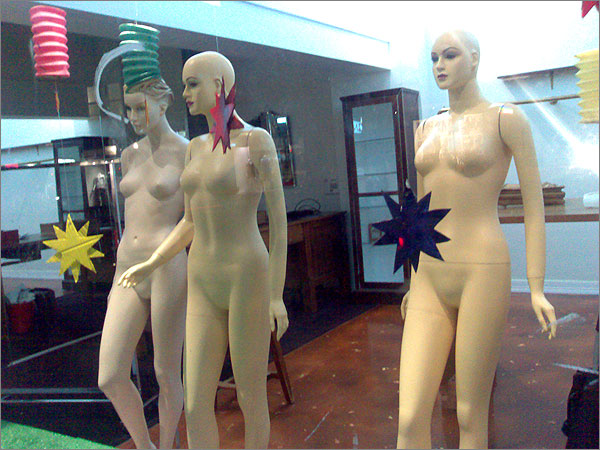
Spotted on Oxford Street, Sydney last night: an abandoned clothing boutique, recently repossessed by the landlord, with these rather forlorn-looking dummies holding an impromptu party.

Word-whore. I write 'em. I talk 'em. Information, politics, media, and the cybers. I drink. I use bad words. All publication is a political act. All communication is propaganda. All art is pornography. All business is personal. All hail Eris! Vive les poissons rouges sauvages!

Spotted on Oxford Street, Sydney last night: an abandoned clothing boutique, recently repossessed by the landlord, with these rather forlorn-looking dummies holding an impromptu party.
A reminder: I’m going to the Australian Computer Society’s Web Technology SIG’s presentation on Web 2.0, in Sydney from 1800 tonight. Apparently the redoubtable Laurel Papworth will be there too, so the presenter from IBM ain’t gonna have an easy time.
I’ll be Twittering it at twitter.com/stilgherrian and writing something afterwards. You don’t need a Twitter account to follow what I’ll say. My Twitterings also appear in the sidebar of my website, but only refreshed every 15 minutes or so.
Headline of the Decade, perhaps? “Police: Crack Found in Man’s Buttocks”. Who’d have thought. “Hagerstown, Md. (AP) — Police searching a downtown home found a man hiding 15 plastic bags of crack cocaine in his buttocks.” Hat-tip to Angus Wheaton.
Bloggerati is running a straw poll on who should go to the Australia 2020 Summit. Some people have been shameless whoring their vote link. So shall I. Click here to vote for me, using the “Vote” button when you get there. It isn’t part of any official process, but it might help someone summarise something, somehow.
“Dare to Know!” is the title of chapter 8 of Iron Kingdom: The Rise and Downfall of Prussia 1600-1947. And the opening words will bring a wriggle of delight to social media evangelists everywhere. (Hi, Laurel!)
The Prussian enlightenment [of the 18th century] was about conversation. It was about a critical, respectful, open-ended dialogue between free and autonomous subjects. Conversation was important because it permitted the sharpening and refinement of judgement. In a famous essay on the nature of enlightenment, the Königsberg philosopher Immanuel Kant declared that:
Enlightenment refers to man’s departure from his self-imposed tutelage. Tutelage means the inability to make use of one’s own reason without the guidance of another. This tutelage is self-imposed if its cause lies not in an intellectual insufficiency, but in a lack of will and courage… Dare to know! [Semper aude!] Have the courage to use your own reason! This is the motto of the Enlightenment!
[…] In the percolation through society of this spirit of critical, confident independence, conversation played an indispensable role. It flourished in the clubs and societies that proliferated in the Prussian lands…
The conversation… also took place in print. One of the distinctive features of the periodical literature of this era was its discursive, dialogical character. Many of the articles printed in the Berlin Monthly (Berlinische Monatsschrift), for example, were in fact letters to the editor from members of the public… The Berlin Monthly was thus above all a forum in print that… was not conceived as fodder for an essentially passive constituency of cultural consumers. It aimed to provide the public with the means of reflecting upon itself and its foremost preoccupations.
In other words, the strength and integrity of the Prussian state came not from the King or the bureaucrats telling everyone how things worked, but from people engaging in an on-going conversation about their own society.
In the age of “emerging social media”, this sounds very familiar…
’Pong’s photos of the urban decay in Bangkok are much better than mine.