My week Monday 15 to Sunday 21 July 2013 is not being recorded here. In any event, no media objects were produced, so there’s nothing of importance to link to.
Weekly Wrap 162: A dog, a pause, and an invisible cat
 My week Monday 8 to Sunday 14 July 2013 was a continuation of my distinct slow-down, for reasons explained previously.
I still haven’t decided whether I’ll write about that any further. For now, I’ll just say that there’s been suitable initial progress on that front. Many thanks to the people — friends, colleagues and strangers alike — who’ve been in touch.
Meanwhile, as usual, here’s the media-related things I’ve done this week. Not that there were many.
Podcasts
None.
Articles
- Microsoft sucked into ever-growing NSA vortex: who’s next?, ZDNet Australia, 13 July 2013.
Media Appearances
- On Monday, I spoke about NSA and spying on Channel TEN’s The Project.
Corporate Largesse
None. Well, there was some on offer, but I declined. I have heard rumour which suggest that I made the wrong decision.
The Week Ahead
The theme for the coming week is “assessment”. I’ll be be running through the various areas of my life to see where I’m up to, what issues I should perhaps address, and what the possibilities for the future might be. Personal stuff, including my health. Work, both media-related and otherwise. All sorts of stuff. I haven’t done that for a while. I’ve just been cruising along.
In between, I’ll be writing for Technology Spectator and ZDNet Australia, and perhaps some others. I’ll also post another episode of the Corrupted Nerds podcast, fix some problems with the website, and sketch out my ideas for making that a sustainable project.
On Thursday I’ll be down in Sydney for a medical appointment and lunch with a friend. Whether I’ll be staying in Sydney longer than that remains to be decided.
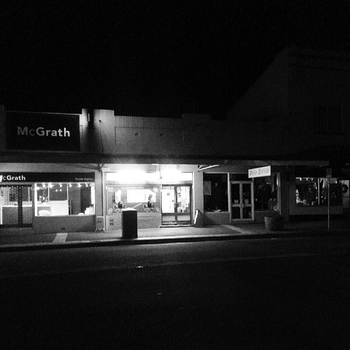
[Photo: Sunday night in the village, being the near-deserted Station Street, Wentworth Falls, earlier this evening.]
Rydges’ daft website contact form
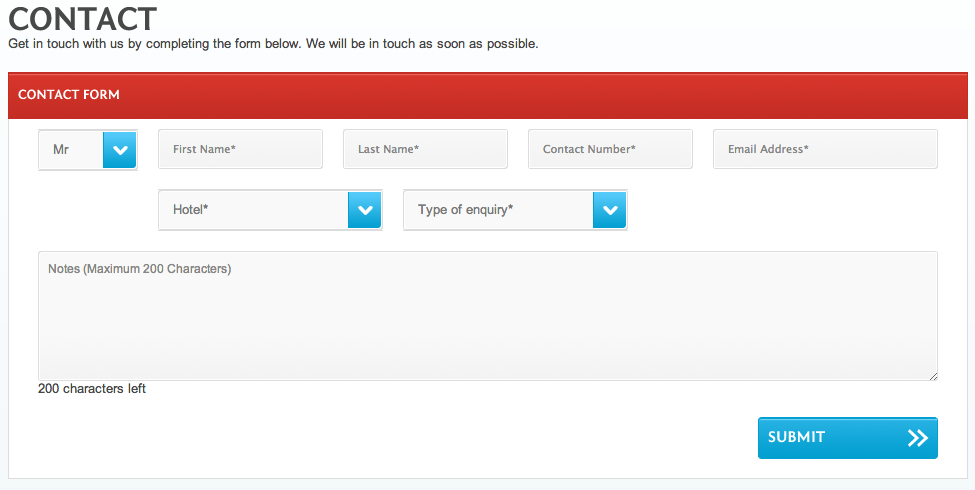 This week’s award for daft user interaction design goes to Rydges, the chain of hotels and resorts, for their incredibly silly website contact form.
Web contact forms can sometimes be useful, I suppose, if a business receives a lot of standard enquiries, because they can capture the structured data and put it straight into the customer relationship management (CRM) system. But most of these forms just dump the form data into an unstructured email, and dump that into some poor soul’s inbox. Why not just publish an email address? Are your spam filters that shoddy?
But when contact forms have badly-worded multiple-choice options, ill-thought-out data validation code, or unworkably small data fields, they make things difficult for everyone — and this one’s got the lot.
According to Rydges, you must have a title, but it can only be “Mr”, “Mrs”, “Ms” or “Miss”, not “Dr” or “Rev” or anything else. Your name must consist of two words. Your phone number cannot start with the “+” that comes before the country code, odd for an international business, nor may it contain spaces. And the “Type of enquiry” drop-down has only two choices, “Business” or “General”.
Is a question about the hotel restaurant’s opening hours, for example, “Business” or “General”, I wonder?
But the pièce de résistance is that the body text is limited to just 200 characters. That’s about 30-odd words of standard English text. Good luck with that.
Talking NSA and spying on The Project
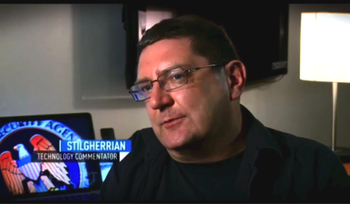 The revelation that the US National Security Agency (NSA) was engaged in such comprehensive spying of American citizens and their allies, some of it possibly unconstitutional, continues to make headlines.
The focus has not narrowed to the manhunt for Edward Snowden as I’d feared. Instead, there’s a steady stream of mainstream news stories as new details emerge — including my third appearance on Channel TEN’s The Project on Monday night.
On the previous two occasions, when I was talking about cyberwar and crimefighting smartphones respectively, I was chatting with the presenters. Since they’re in Melbourne, that involved sitting in front of a green screen and looking down the barrel of a camera as if it’s your best friend.
But this time my comments were to be included in a stand-alone “package”, as they’re called, along with comments from Fairfax journalist Philip Dorling and others. So a videographer came to my hotel room on Friday afternoon to shoot me at my desk, while the Melbourne-based journalist asked me questions via speakerphone — and I looked toward a yellow piece of paper that indicated where the journalist might have been standing had he actually been there.
Ah, the magic of television!
The video of the three-and-a-half minute segment, including comments fore and aft by the presenters, is over the fold.
Weekly Wrap 161: The black dog and the prodigal umbrella
 My week Monday 1 to Sunday 7 July 2013 was another complicated one, as already explained. That’s why this post is very late, of course.
Once I’d gotten the bigger chunks of work out of the way, I pulled the pace back a bit — which I think you’ll agree was sensible.
I was also pleased to see the return of the prodigal umbrella. The excellent umbrella I was given by Verizon Business in Singapore had been left at a noodle bar months ago — but the owners remembered it and me. We were reunited last Wednesday. Also, pho was served.
Podcasts
None.
Articles
- UNSW helps close cloud computing’s can of (legal) worms, CSO Online, 3 July 2013.
- The 10 Commandments of Data Sovereignty, CSO Online, 3 July 2013.
- ATO’s clunky E-tax for Mac highlights cultural problems, ZDNet Australia, 5 July 2013.
Media Appearances
- On Friday, I was interviewed for a segment on Channel TEN’s The Project. However it didn’t air until Monday 8 July, so it’ll get its own blog post shortly, and be included in next week’s wrap.
- On Sunday I was a guest on Reckoner episode three, as already explained.
Corporate Largesse
- On Tuesday I attended the launch of the University of New South Wales’ report Data Sovereignty and the Cloud — A Board and Executive Officers’ Guide at the Sydney offices of law firm Baker & McKenzie. Refreshments were served.
The Week Ahead
It’s almost over, so I’ll just mention that I’ll be writing for ZDNet Australia tomorrow, Friday, and I’ll be returning to the Blue Mountains on Sunday, probably.
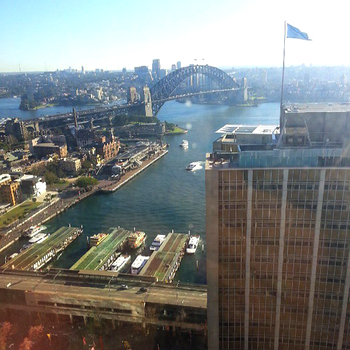
[Photo: Sydney Harbour, viewed through a dirty window in the AMP Tower, photographed on 2 July 2013.]
Talking many things on the Reckoner podcast
 On Sunday I was a guest on the podcast Reckoner with hosts Peter Wells and James Croft, which has been badged Episode Three | Freedom Of Choice.
We spoke about the Australian Taxation Office’s clunky e-tax for Mac software; Choice encouraging people to bypass geo-blocking to get at the digital content they want; a chap called Mattrick moving from Microsoft to Zynga; Yves St Laurent CEO Paul Deneve joining Apple; Samsung buying Boxee; and Twitter client Falcon Pro for Android going free, but gaming Twitter’s user-token limits.
There’s links to all those things on the episode page. That’s three links to that page now, so you should click on one of them. Go on.
That said, here’s the audio right here, embedded in this page so it’ll also appear in my Conversation podcast feed.
Podcast: Play in new window | Download (Duration: 48:27 — 22.2MB)
The audio is Copyright ©2013 Reckoner.