Vale Tristram Cary, 1925-2008

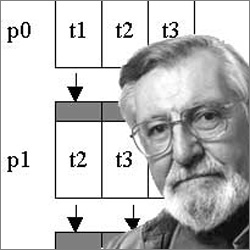
Photograph of Tristram Cary

The godfather of British electronic music, composer Tristram Ogilvie Cary OAM, died on 24 April 2008. He was aged 82.

Cary’s story is told in his Wikipedia profile and the Times Online obituary. If anyone outside the “serious music” world knows him, it’s usually for writing the soundtracks for early Doctor Who episodes and films (which he hated talking about), or the Hammer Horror movies Quatermass and the Pit (1967) and Blood from the Mummy’s Tomb (1971).

However Cary was also a pioneer of music synthesisers. Trained as a radar technician in WWII, he co-founded Electronic Music Studios (EMS), which created the first portable synthesiser, the VCS 3.

I worked briefly with Cary one summer as a programmer. He was director of the electronic music studio at the Elder Conservatorium of Music in Adelaide. I wrote a digital filter in PL/1 (!) for what I think was the Synclavier synthesiser — though it may have been something else, because as a hardware hacker Cary was well wicked. In his studio, it was difficult to see where one machine ended and the next began, they were so cross-linked.

I remember he was particularly fascinated with the sounds of bells, which then were starting to become achievable through digital synthesis. It was the first time I’ve ever found my applied mathematics knowledge of Fourier Transforms to be even remotely useful.

If you enjoy any kind of electronic music, you should take an hour of your day to learn more about Tristram Cary. He made your world.

[Footnote: I found out about Tristram Cary’s death from a most unusual source: the end credits to Shaun Micaleff’s program Newstopia. The more I discover about you, Shaun, the more I think my initial assessment of you as an arsehole was a mistake.]

Oh you poor, dear record companies…

You’ve got to hand it to “the music industry”. This week they released a propaganda film Australian Music In Tune which asks us to sympathise with musicians because they’re all poor struggling artists. Diddums.

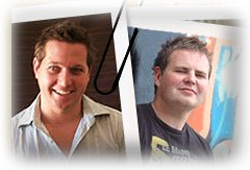
Photograph of Jared Madden and Adam Purcell

The only reason musicians trying to “make it” are poor is that as soon as they do get that sought-after recording contract they still pay for everything from there on. Before they see a single cent from their music, they have to pay off the studio hire, recording engineer, video director, stylists, set designers, editor and dozens of other parasites — including music company executives with their nice lunches and their BMW leases.

An entire industry — “the music industry” and their retail outlets — sits between the musicians and their audience, sucking out something like 90% of the money in the process.

And they have the gall to rope musicians into their propaganda film under false pretences, telling people like Frenzal Rhomb’s Lindsay McDougall that it was a movie about life as an artist.

He said he was told the 10-minute film, which is being distributed for free to all high schools in Australia, was about trying to survive as an Australian musician and no one mentioned the video would be used as part of an anti-piracy campaign.

OK, so who are the guys in the photo? Jared Madden (left) and Adam Purcell (right) have created tune-out.com in response to the industry crying poor.

Continue reading “Oh you poor, dear record companies…”

I came for the gin, I stayed for the social revolution

Photograph of Bombay Sapphire Gin bottle

“Television, the drug of the nation / Breeding ignorance and feeding radiation,” rapped American poet and musician Michael Franti of the Disposable Heroes of Hipocrisy Hiphoprisy”, now of Spearhead. Could this literally be true?

I’ve just read the most amazing speech, Gin, Television, and Social Surplus by Clay Shirky, which you can also watch on Blip.tv. It begins:

A British historian [argued] that the critical technology, for the early phase of the industrial revolution, was gin.

The transformation from rural to urban life was so sudden, and so wrenching, that the only thing society could do to manage was to drink itself into a stupor for a generation. The stories from that era are amazing — there were gin pushcarts working their way through the streets of London.

And it wasn’t until society woke up from that collective bender that we actually started to get the institutional structures that we associate with the industrial revolution today. Things like public libraries and museums, increasingly broad education for children, elected leaders — a lot of things we like — didn’t happen until having all of those people together stopped seeming like a crisis and started seeming like an asset.

Shirky goes on to argue that when WWII ended, we suddenly had to cope with another social surplus: all that leisure time thanks to a 5-day working week and all those new-fangled gadgets which made household chores a breeze. So what did we do? We slothed in front of the TV. For a generation.

As we turn off our TVs and connect to each other, this cognitive surplus is creating things like Wikipedia. An estimated 100 million hours of work has gone into it. Yet this is but a drop in the ocean…

Continue reading “I came for the gin, I stayed for the social revolution”

Anzac Day Rememberings

Photograph of a sprig of rosemary, for remembrance

Where the fuck do I start? For me, Anzac Day is a tangled mess of emotions and ideas — some about grand themes of global and national politics, others deeply personal.

What pleases me most about Anzac Day is that Australia and New Zealand commemorate the sacrifice of their war dead not through parades of tanks and missiles and a glorification of war but with highly personal ceremonies of remembrance starting before dawn.

We talk not of our nation’s military prowess — though Australia is, by all accounts, capable of fielding professional military forces which make almost everybody else look like disorganised amateurs — but of the personal qualities which have made this nation great.

Those qualities were listed in an Army recruitment advertisement designed by a soldier. They were reiterated this morning by Major General Mark Kelly:

Regardless of religion, racial background, or even place of birth, we gather not to glorify war, but to remind ourselves that we value who we are and the freedoms we possess, and to acknowledge the courage and sacrifice of those who contributed so much in shaping the identity of this proud nation…

The term Anzac has transcended the physical meaning to become a spirit, an inspiration which embodies the qualities of courage, discipline, sacrifice, self reliance, and in Australian terms, mateship, and a fair go. This is what Anzac means to me.

These are the qualities which once gave Australia such a fine reputation overseas — before our foreign policy became one of subservience to American Neocons, and before symbols of military might were perverted into supporting a never-ending War on Abstract Nouns. Before quiet patriotism turned into loud but ignorant flag-draped jingoism. John Birmingham wrote about this in his Quarterly Essay, A Time for War: Australia as a Military Power. But what does it all mean now under Chairman Rudd?

Continue reading “Anzac Day Rememberings”

ABC Playback: so this is the future of television…? Nope!

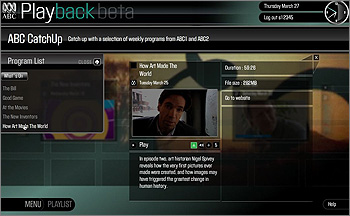
Screenshot from ABC Playback

On Thursday an email told me that I’m a beta tester for ABC Playback, the Australian Broadcasting Corporation’s Internet TV trial. So here we go…

I’ll gloss over the geeky stuff because the massively-brained Simon Rumble has already done a technical reconnaissance. Just three key points there from me:

  1. It uses a Flash front end over XML program listings. Simon reckons it’ll be easy to hack up a Linux version for those who can’t use the official Windows and Mac interface. Or who want to avoid the pointless animations. Or who’d rather an easier-to-read high-contrast interface than trendy translucency.
  2. A 30-minute program is compressed to a mere 130MB, which seems a reasonable compromise between quality and bandwidth — at least for infotainment — given the ABC’s need to serve regional audiences out on the Information Super-goat-track.
  3. Did we really need to spend taxpayers’ money putting a clock in the top right of the screen? Computers already have clocks.

Technically it works just fine… but that’s not the real issue…

Disappointingly, ABC Playback seems more like the last gasp of old-style broadcast TV than a prelude to something new and wonderful.

Continue reading “ABC Playback: so this is the future of television…? Nope!”

Super Hornets are Go

Photograph of US Navy F-18E Super Hornet aircraft

Defence minister Joel Fitzgibbon has announced that the controversial purchase of 24 Super Hornet aircraft will go ahead.

The review of the Howard government’s decision to buy the aircraft — at a total cost of $6 billion even though the RAAF hadn’t wanted them — reached some damaging conclusions, including:

  • There has been a lack of sound, long-term air combat capability planning decisions by the former Government over the course of the last decade.
  • The retirement of the F-111 was made in haste but is not irreversible. The cost of turning the F-111 back on would be enormous and crews and skills have already moved on.
  • The former Government’s decision to leave Australia’s air defences in the hands of the Joint Strike Fighter project was a flawed leap of faith in scheduling terms and combined with the quick decision to retire the F-111 early, allowed an air combat capability gap to emerge.
  • The subsequent timetable the former Government put on the acquisition of an interim fighter left Defence planners with no choice but to recommend the Super Hornet. No other suitable aircraft could be produced to meet the 2010 deadline the former Government had set. One year on, that is now even more so the case.

Cancelling the order would still incur a financial penalty and create “undesirable tensions”, and the final conclusions is that “the Super Hornet is an excellent aircraft… and is the only aircraft which can meet the small delivery window created by the former Government’s poor planning processes and politically-driven responses.”

As a shareholder in Australia Inc, I’d like to know why the former “board members” allowed this to happen. When company directors are negligent they become personally liable so why, given the report’s damning conclusions, does Brendan Nelson not become personally liable?

Continue reading “Super Hornets are Go”